



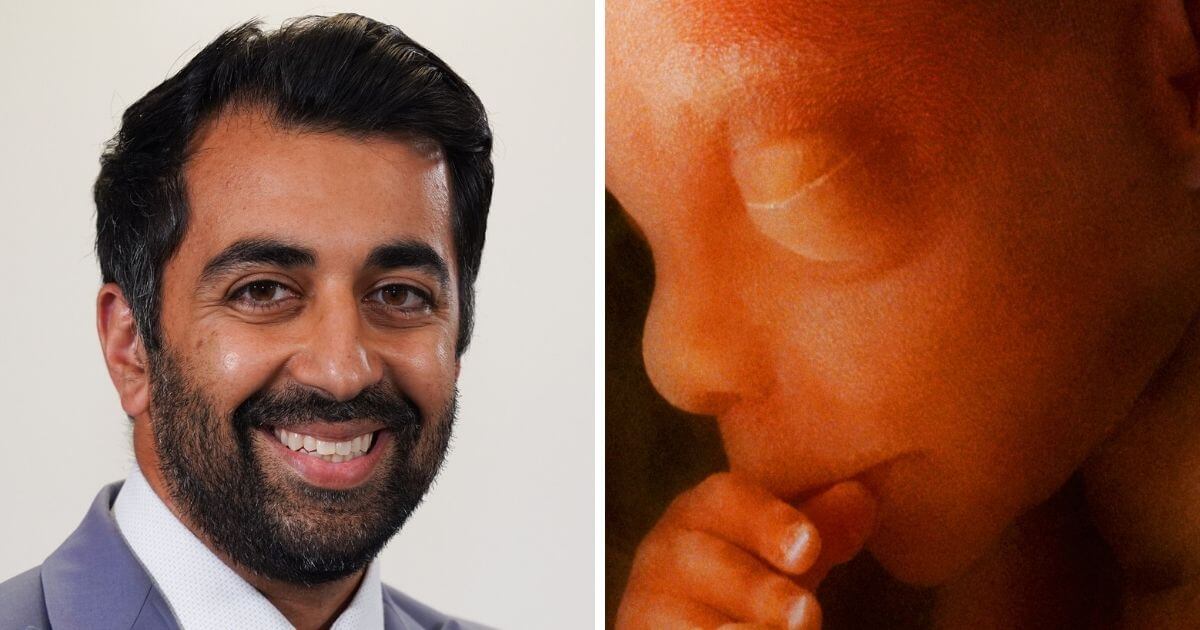
Humza Yousaf, who is running to be the next First Minister of Scotland, has committed to removing abortion from the criminal law, which would introduce abortion on demand, for any reason, up to birth in Scotland – along with legalising sex-selective abortion.
The three candidates for the next First Minister of Scotland were approached by campaign group, Back Off Scotland, asking them whether they supported three changes to abortion legislation. Back Off Scotland is the Scottish arm of the Back Off campaign, which is run by the UK’s largest abortion provider, the British Pregnancy Advisory Service (BPAS).
The third of the three proposed law changes is “removing abortion from the criminal law”.
Humza Yousaf then announced on Twitter that he would support all three changes, including “bringing forward decriminalisation proposals in current parliament term”.
Abortion on demand, for any reason, up to birth
Currently abortion is a crime under common law in Scotland. While abortion is technically a crime, the Abortion Act provides exemptions under which abortion can take place. This in practice allows abortion to be available on request through to the 24-week limit outlined in the Abortion Act.
The abortion provider, BPAS, is campaigning for abortion to be fully ‘decriminalised’ in Scotland, England and Wales. In England and Wales, this would involve repealing sections 58 and 59 of the Offences Against the Person Act along with the Infant Life Preservation Act. In Scotland, this would involve introducing a new law clarifying that abortion is not a crime.
As the Abortion Act 1967 was passed to create exemptions to criminal law in Scotland, ‘decriminalising’ abortion would involve introducing a new law clarifying that abortion is not a crime and this would make the Abortion Act 1967 redundant in Scotland.
This change in law would scrap the current 24-week time limit for abortion – and abortion would be available on demand, for any reason, up to birth. The upper time limit would be completely abolished.
Abortion provider BPAS, who have been campaigning for this law change, have made it explicit that they are campaigning to remove all gestational time limits for abortion.
This position was affirmed by their then CEO, Ann Furedi, who at the launch of the campaign to ‘decriminalise’ abortion stated, “I want to be very, very clear and blunt … there should be no legal upper limit”.
In an email to a member of the public that was shared with Right To Life UK, Back Off Scotland confirmed that they “would be looking for full decriminalisation”. They also outlined that they are working with the abortion provider BPAS on the proposed change to the law.
The proposed change to the law would leave Scotland with one of the most extreme abortion regimes in the world. The change would position Scotland drastically away from the European Union, where the most common abortion time limit among EU countries is 12 weeks.
The proposal is also completely out of line with where women stand on the issue. Polling from Savanta ComRes on whether time limits for abortion should be increased showed that only 1% of women in Great Britain wanted the time limit to be extended to more than 24 weeks and 1% wanted it to be increased right through to birth, in contrast to 70% of women who favoured a reduction in time limits.
There was an enormous backlash when the head of the Royal College of Midwives committed to supporting BPAS’ campaign to ‘decriminalise’ abortion and introduce abortion up to birth.
Following that backlash, high-profile politicians appear to have been wary about supporting making the law change proposed by the campaign, that is until Humza Yousaf announced his support for that law change this week.
Sex-selective abortion would also be legalised
In their letter to the three leadership candidates, Back Off Scotland specifically outline some of the current provisions in the Abortion Act that would be made redundant if abortion was ‘decriminalised’ in Scotland.
They state “Currently, abortion in Scotland is not a right. Women still need the approval of two doctors, must meet one of the five grounds for having an abortion… all because abortion is governed by the criminal law.”
As Back Off Scotland have identified, the Abortion Act provides for abortion to be performed only under specific grounds.
Sex selection is not one of the current grounds under which abortion can be performed and, therefore, sex-selective abortion is currently illegal in Scotland.
If the Abortion Act was made redundant, abortion would not be restricted to happening only under the grounds outlined in the Act and abortion could happen for any reason in Scotland.
Without this legal safeguard, sex-selective abortion would be made legal in Scotland.
Sex-selective abortion usually targets baby girls due to a preference among certain parents and some cultures for having sons.
There is evidence that sex-selective abortion has been a problem in other jurisdictions where abortion has been ‘decriminalised’ and abortion is available on demand.
Canada’s abortion law was struck down in 1998, introducing abortion on demand.
Sex-selective abortion has been identified as a major issue in Canada, with an article in the Canadian Medical Association Journal outlining that “easy access to abortion and advances in prenatal sex determination have combined to make Canada a haven for parents who would terminate female fetuses in favour of having sons…”.
Evidence of sex-selective abortions has been found in the Australian territory of Victoria, which ‘decriminalised’ abortion in 2008, and a number of other Australian states have ‘decriminalised’ abortion since then.
Following the law change in Victoria, Dr Mark Hobart was investigated by the Medical Board of Victoria for failing to refer a woman for a sex-selective abortion. Additionally, Australian broadcaster SBS revealed there are higher numbers of boys than girls being born in some ethnic communities in Australia.
A study from La Trobe University, analysing more than a million births in Victoria, suggests some parents could be aborting unborn female babies in order to have a son.
This change to the law is also out of line with where women stand on the issue. Polling from Savanta ComRes shows that 91% of women agree that sex-selective abortion should be explicitly banned by law.
According to Back Off Scotland, the other front runner in the race to be First Minister of Scotland, Kate Forbes, has not committed to ‘decriminalising’ abortion. Ash Regan, who is currently trailing Kate and Humza in the polls, has committed to “removing abortion care from criminal law.”
In an interview on ITV’s Loose Women, the then CEO of BPAS, Ann Furedi, reaffirmed the position that abortion should be available up to birth along with stating her support for allowing sex-selective abortions to take place in the UK.
Backing an extreme proposal brought forward by radical pro-abortion campaigners
Catherine Robinson, spokesperson for Right To Life UK, said “Removing abortion from the criminal law would introduce abortion on demand, for any reason, up to birth in Scotland, along with legalising sex-selective abortion.”
“Humza Yousaf has committed to a change to abortion law, proposed by radical pro-abortion campaigners, that would see the upper time limit completely abolished in Scotland. Abortion would be available on demand, for any reason, right through to birth. This means abortion throughout pregnancy.”
“Polling shows that this extreme proposal is not supported by women, with only 1% of women wanting the abortion time limit to be increased right through to birth.”
“Are the 13,758 lives lost to abortion in Scotland in 2021, the fourth highest on record, not enough for Humza Yousaf? It appears not.”
“Police Scotland recently confirmed to The Guardian that they had no recent cases of women being charged for procuring an abortion in Scotland. So it is disingenuous for politicians and campaign groups to claim that they are seeking this law change to stop prosecutions. What decriminalisation is really about here is making radical changes to abortion legislation that would allow abortion up to birth, a change in the law that polling shows the general public and women, in particular, are totally against.”
“Humza Yousaf should be committing to bringing forward sensible new restrictions and increased support for women with unplanned pregnancies. This would ensure we were working together as a society to reduce the tragic number of abortions that happen each year.”